Archives
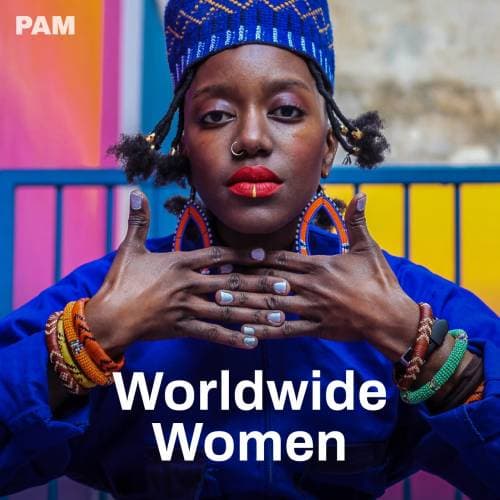
For this International Women’s Day, PAM has compiled a playlist in which African or Afro-descendant women are the central characters. It is meant as a tribute to women, their struggles, as well as their past and future victories.
In 1910, when members of the Socialist International met in Copenhagen, Clara Zetkin, a German feminist activist, proposed to dedicate a day to the mobilization of women around the world. The objective was to claim the right to vote, but also to eradicate sexist discrimination in the workplace. March 8 is now recognized by the United Nations and has, in recent years, led to numerous strikes and demonstrations, some of them large-scale, as in Argentina, Spain, Poland and Turkey.
In spite of the many efforts both men and women still have to make collectively, we have chosen to celebrate this day with music by highlighting one hundred women of African descent who have had impact this year, and who evoke in their art (and in all musical genres) different aspects of femininity (whether they are leading or featuring). That’s why the album Ranavalona by Awori & Twani, released on March 5, comes at just the right time. The Ugandan singer and rapper dedicated this project to the last queen of Madagascar, Ranavalona III, in order to celebrate the great pan-African female figures, who are too often forgotten: “I think this queen fought in her own way, trying to preserve her culture and her people. I think that even when it doesn’t end in a happy ending, it doesn’t matter, the struggle also deserves to be celebrated.”
The Malian rapper Ami Yerewolo also invites us to persevere in the fight against sexism with her song “Ibamba,” which comes with a video that pits beautiful sonority against the cruelty of school harassment suffered by young girls who might not fit societal ideals of feminity. Ami Yerewolo has joined forces with many female artists around the world, including Pamela Badjogo, with whom she co-founded the Malian feminist collective Moussoya yé kobayé. This Gabonese Afro-jazz singer has also dedicated her single “Toto” to female solidarity in the face of every-day sexism. Pamela Badjogo is also a spokesperson for the association “Fées-ministres,” which supports survivors of domestic violence in their legal proceedings. The young Portuguese artist Nenny also recounts the obstacles she has faced in her career through “Tequila,” a song tinged with afrobeats. In “Ftila,” the Moroccan rapper Khtek gives a sharp assessment of sexism, while paying homage to her origins: “Amazigh in our roots, that’s why we are not passive and why the name Khtek is in the classics.”
At the same time, many artists champion a strand of sensuality that helps to emancipate women from the burden of a criteria of beauty that is imposed by society. For example, the New Yorker rapper Junglepussy advocates positive sexuality, a theme that is becoming increasingly popular within feminism. Criticizing the harmful consequences of toxic masculinities, she expresses this poignant observation in “Morning Rock”: “I have to hate myself for you to love me.” This echoes Dawn Richard’s video for “Bussifame,” in which black dancers, of all shapes and sizes captivate the viewer, mocing to a rhythm borrowed from footwork, house and R&B. She defines her latest album Second Line: An Electro Revival as: “A movement to bring black women pioneers of electronic music to the forefront of the scene. I want to be the one to motivate a young black woman in the Southern United States to be what she wants to be musically, visually or artistically.”
In addition, several artists evoke the sexism that exists within couples (in this case, heterosexual), such as the Moroccan singer Manal with her track “Niya,” meaning “naive,” which arrives alongside a video paying tribute to the “sheikhattes,” singers and dancers both admired and despised for their supposed lack of modesty. New Zealand’s Estère, of Cameroonian origin, also evokes “the irrepressible attachment that can bind us to someone who is not good for us - the impulse to want to save a person, despite the harm they may have done to us.” Cape Verdean Elida Almeida, for example, explores the atrocity of feminicide in “Sai Bu Sai”: “Every day I read stories of feminicide in the press. Some of them made me cry. I wanted to compose this song like a letter written by a woman to her husband who killed her.”
In the face of these numerous forms of violence, artists gather in the spirit of sorority. The British artist Hope Tala reminds listeners of how women don’t hesitate to fight back, with her song “All my girls like to fight” about an alliance of women disappointed by the same man. As for the transgender artist Dian, from Senegal, she has released the hypnotic single “Bailerina,” which marks a soulful tribute to a lost friend, affirming how women who are no longer of this world are still great sources of inspiration. Ivorian rapper Andy S dedicates her new single “Amazone” to the power of women. In the track, released March 8, she says she is: “Alone in my area because I have the behavior of a powerful warrior, an Amazon.”
There are so many examples of music that acts as testimonial, hammering home the message: “you are not alone” as Arlo Parks does on her track “Hope.”
Listen to our Worldwide Women playlist on Spotify and Deezer.