Archives
On their debut release titled buffering juju, out now on the Mushroom Hour label, the nomadic folk duo of dumama+kechou offer up takes, re-takes, fixes, and sedimentary reduxes to the sound otherwise known as electronic music.
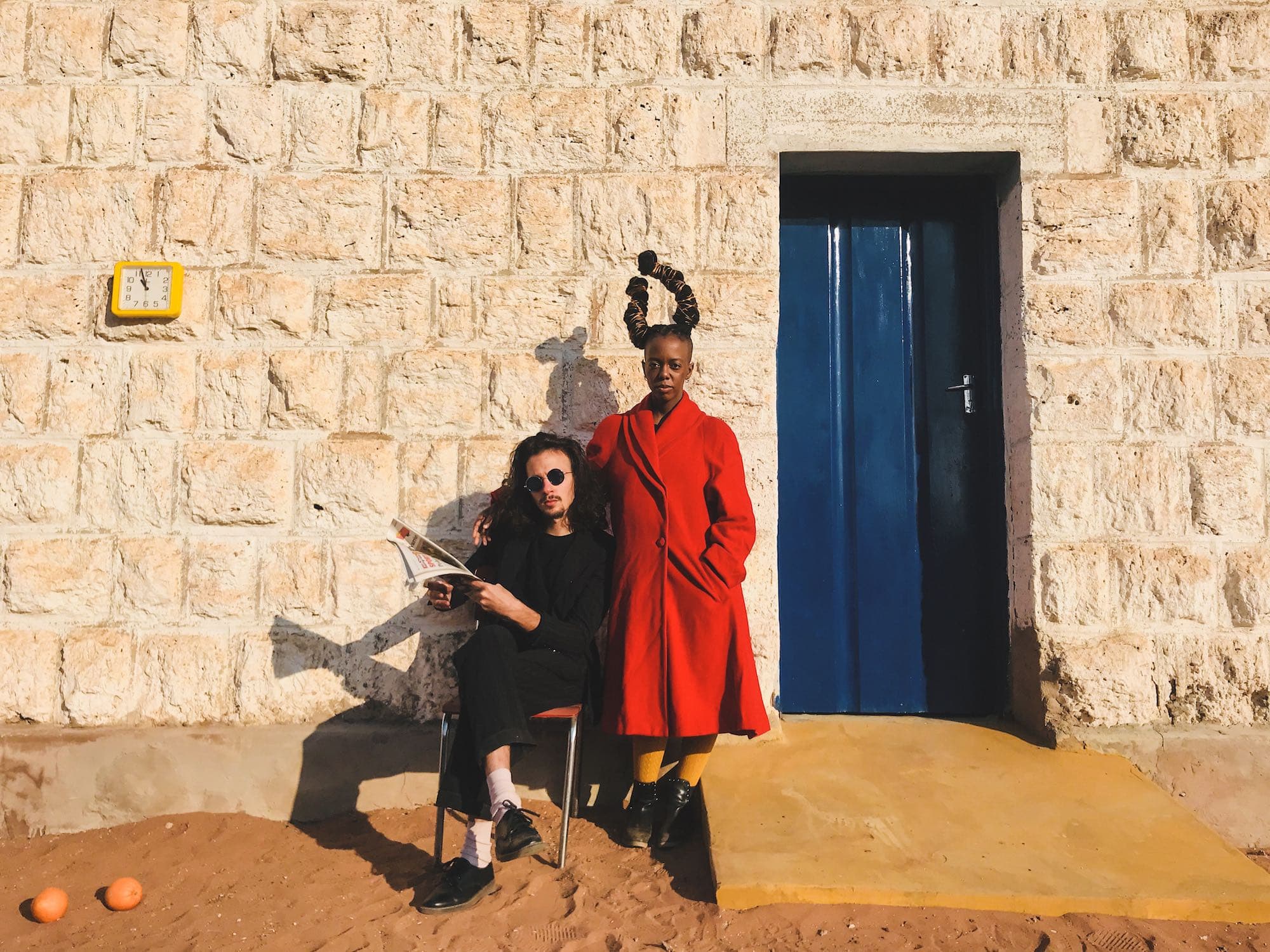
Comprising troubadours Gugulethu Duma (vox/synth/uhadi) and Kerim Melik Becker (beats, instrumentation), dumama+kechou are a welcome addition to the cosmic soundscape that borrows from the ideas of creators like Sun-Ra and Alice Coltrane, and filters them through the polyrhythmic isiXhosa incantations of Madosini, under whom Dumama studied the uhadi instrument (the South African equivalent -and surely African ancestor- of Brazilian Berimbau). The results are fed back into a continuous loop that opens tabs to other regions. In this regard, the Sahel is fully represented via Kechou’s desert blues-inspired, hip hop-leaning beats and instrumentation. Further sonic manipulations take place, an approach dumama describes as “open-ended and unfixed.”
About their meeting, Kechou offers: “First we met. Then we started jamming. And then we [kind of] sneaked into a show as an opening act. But we didn’t quite feel ready. And then we played this amazing show. [That’s when] we figured we could do this.”
The album was mostly recorded over a two-week period in February 2019, during the duo’s residency at the Nirox Sculpture Park located on the outskirts of Johannesburg. It was produced in conjunction with electronic beat-freaque and studio wizard Dion Monti. Additional sessions took place in Cape Town and Berlin, where Kechou is based, while Angel Bat Dawid, featured on “uveni”, recorded her parts in Chicago. The free jazz thespian isn’t the only one who joins the cypher; Dylan Greene, Nobuhle Ashanti, Odwa Bongo, and Siya Makuzeni also appear on the 8-track vibe-adelic masterpiece.
Dumama was particular about what she wanted to explore, going into the record. The intro (“Leaving Prison”) for one, is a song about the infamous Fort Glamorgan Prison in East London, South Africa. The slammer has ensnared some of the greatest anti-Apartheid struggle figures. The Black Consciousness revolutionary leader, thinker and activist Steve Biko was one. The tune was also adopted by students during the 2015 and 2016 protests known as #FeesMustFall (though the movement wasn’t just about fees, but the need to decolonize the entire education system in South Africa).
In this way, the song became Kendrick Lamar’s “We Gone Be Alright” for the now-generation of fed up post-’94 South Africans, who arrived at the realization that Rainbowism was but a concoction fed to black and brown people in the hope that they forget about the greater issues at hand -- access to land, affordable living wages, functional health and education systems, and a general ‘better life for all’, to paraphrase the ANC’s promise going into the first democratically held elections.
Furthermore, the song appears on Miriam Makeba’s An Evening with Belafonte and Makeba (1965). In adapting the lyrics of “Nonqonqo” to fit into her sonic vision, Dumama pays homage to the old and the new, while also assuming her place as a future ancestor in the realm of radical, free-thinking children of the light.
“The songs kind of just landed in me when I was going through my identity inquiries, which I feel like is a never-ending research. And the thing that really stuck out to me was the idea of matriarchs, specifically Xhosa matriarchs -- from umama uMadosini, to both of my grandmothers who are still alive that have kept me and my sister and my parents going, spiritually speaking. And my mother as well, and then my sister, and then me; our experiences seem to mirror [each other] in different timelines. But symbolically, we experience the same struggles as black women [living] in a dislocated-feeling country” she says.
“For Madala” with Nobuhle Ashanti and Odwa Bongo is a tribute to the musical might of Madala Kunene. The original, “Ubombo”, is a song about accepting one’s ancestral calling and giving in to what Nduduzo Makhathini would call “the underworlds”, broadly speaking. dumama+kechou flip it to a sci-fi joint about a woman and her baby … “[transforming] into one owl speaking to mhlekazi (your excellency), the being responsible for the pain […] the owl implores mhlekazi to interrogate why he chooses to silence her,” reads part of the story from which the song titles derive.

The duo find kinship in Sibusile Xaba, who also pays homage to Madala Kunene on his latest album, on the song titled “Tribute to Bafo”. The performance outfit, The Brother Moves On, have also played their bit in honouring the longstanding mastermind whose albums via labels such as MELT2000 and Madaline serve as inspirational organic sauce for live music in South Africa today. Smith and Mighty have in the past given it a drum&bass fix, while Rudeboy Paul lent it the tribal house treatment on his Azanian Pulse Vol. 1 (2003).
“It’s a storyline”, says dumama about the nature of buffering juju. “It’s open-ended in the sense that there is no direct end to it. Even the way we set it up, each song is kind of spilling into the next, or spilling into some sonic field that comes back all the time. So it’s definitely more of a journey than song, song, song...planned.”