A hybrid music
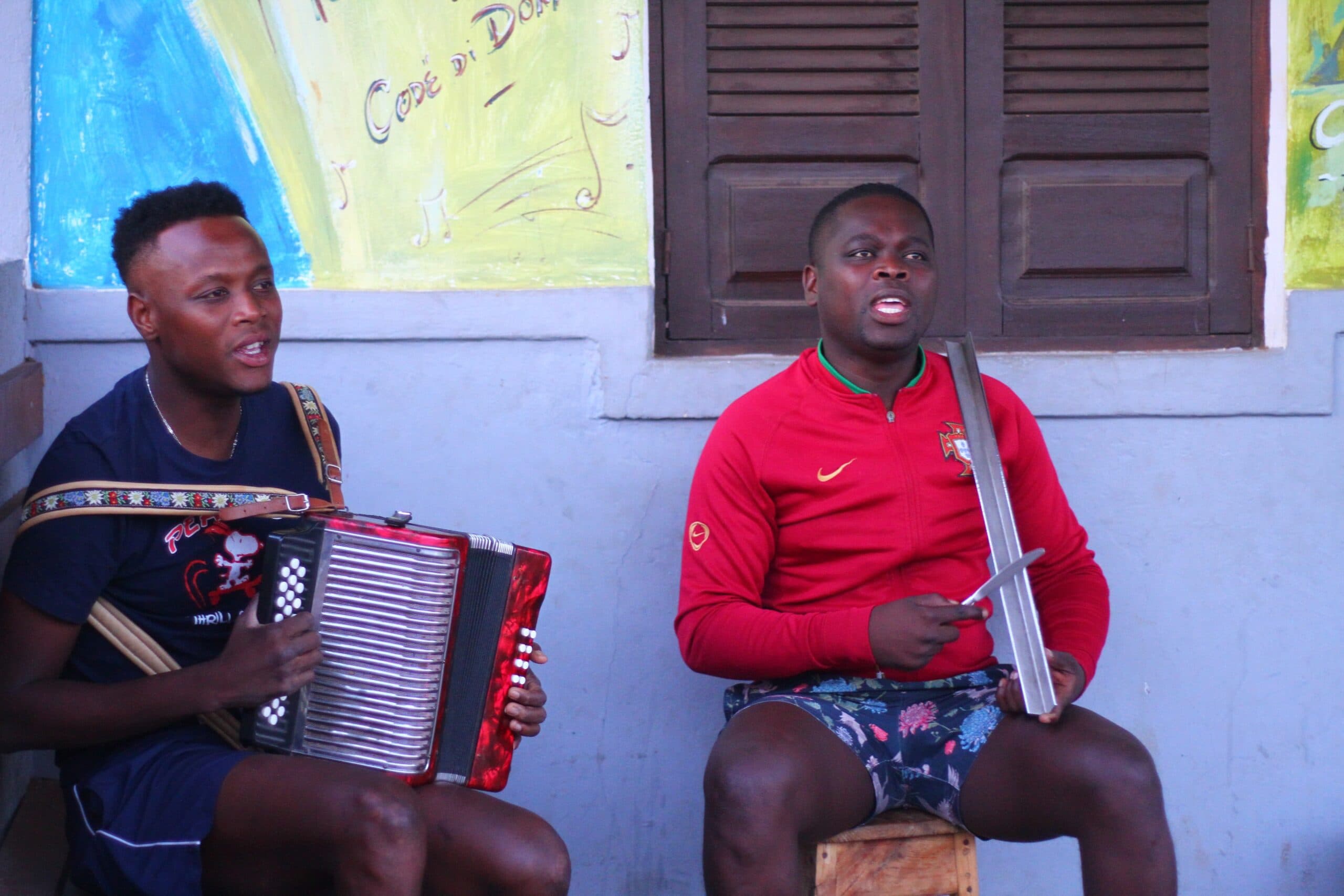
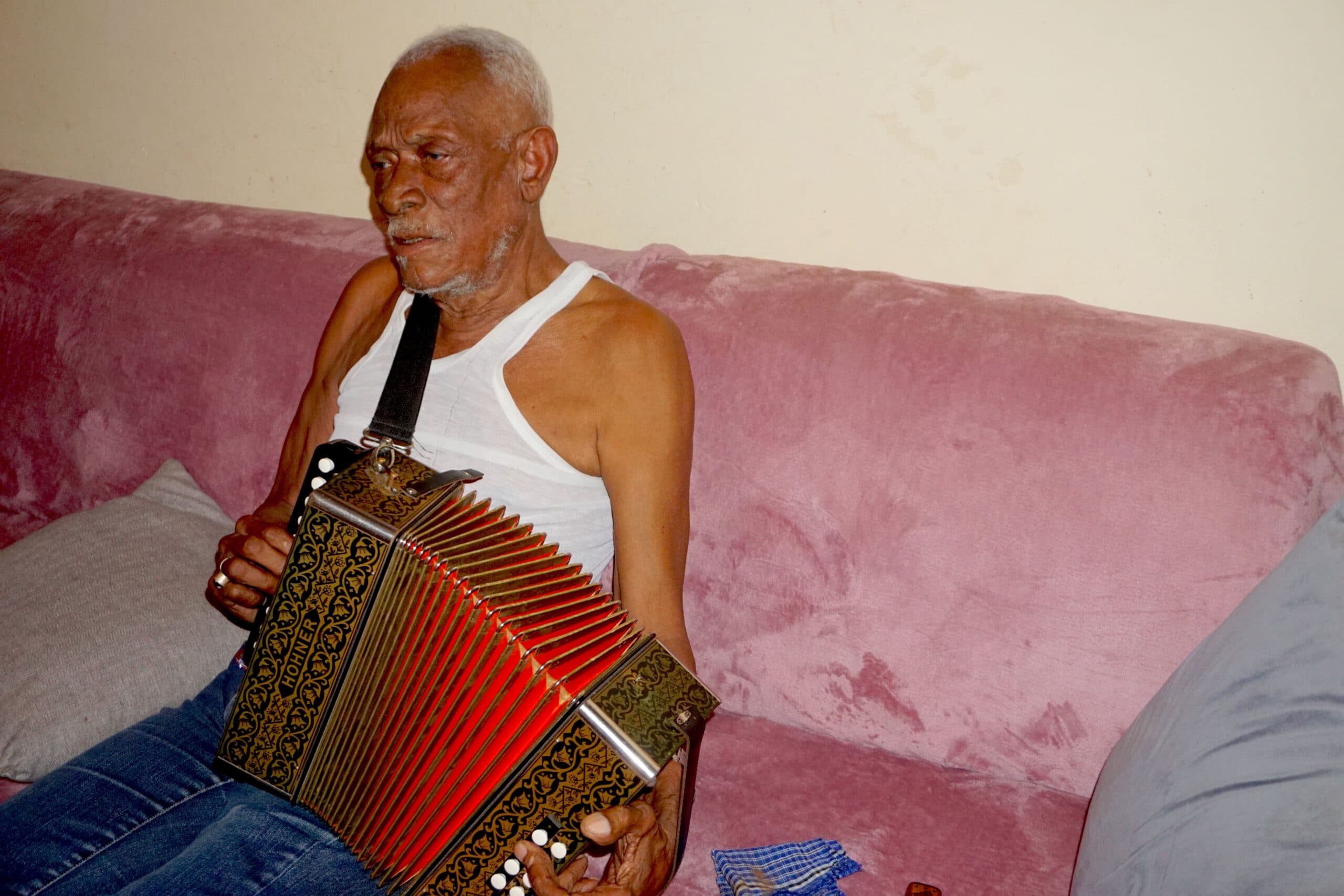
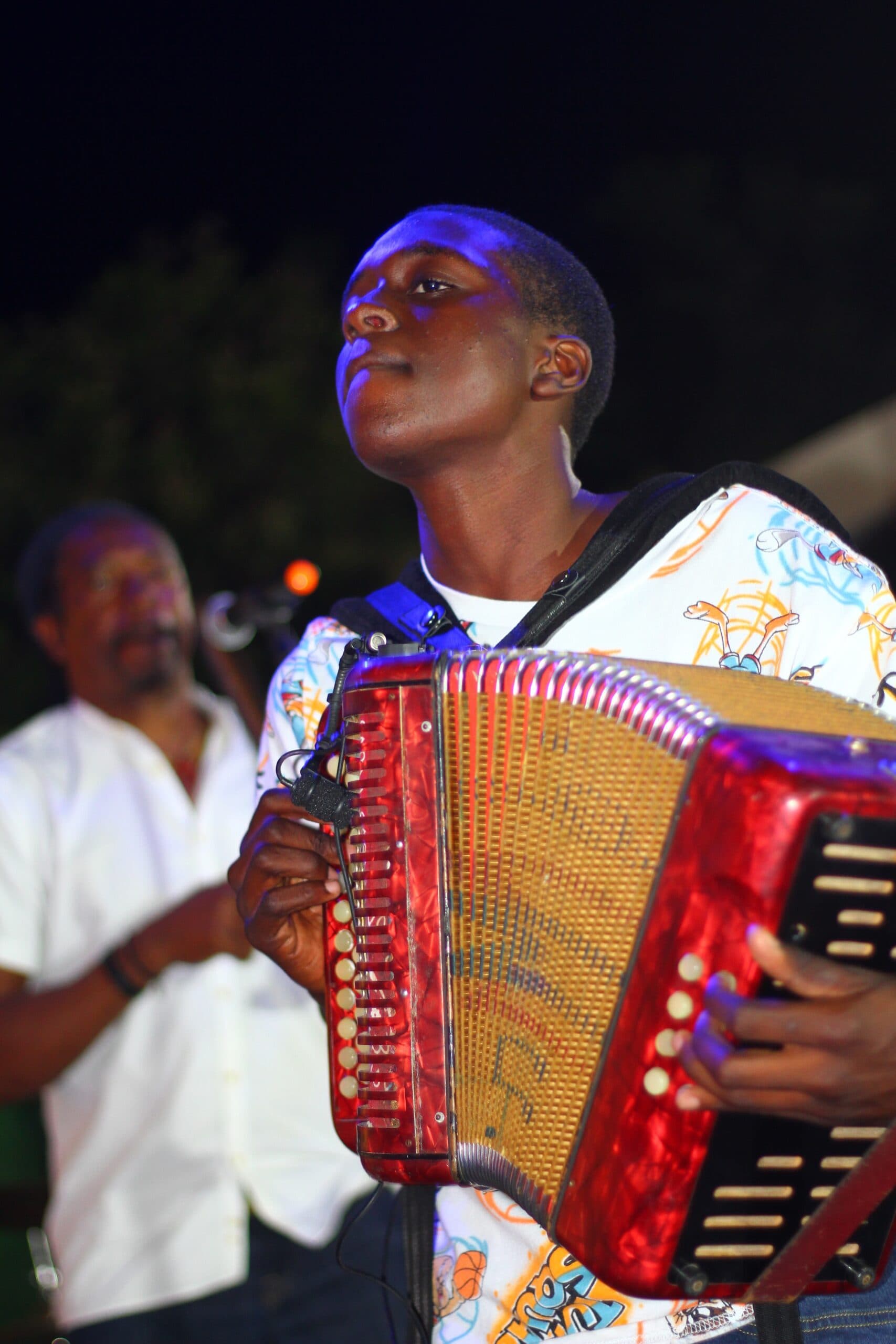
The accordion plays an absolutely central role in funaná. Though before it is played in Cape Verde, the instrument must first pass through the nimble hands of a Cape Verdean luthier.
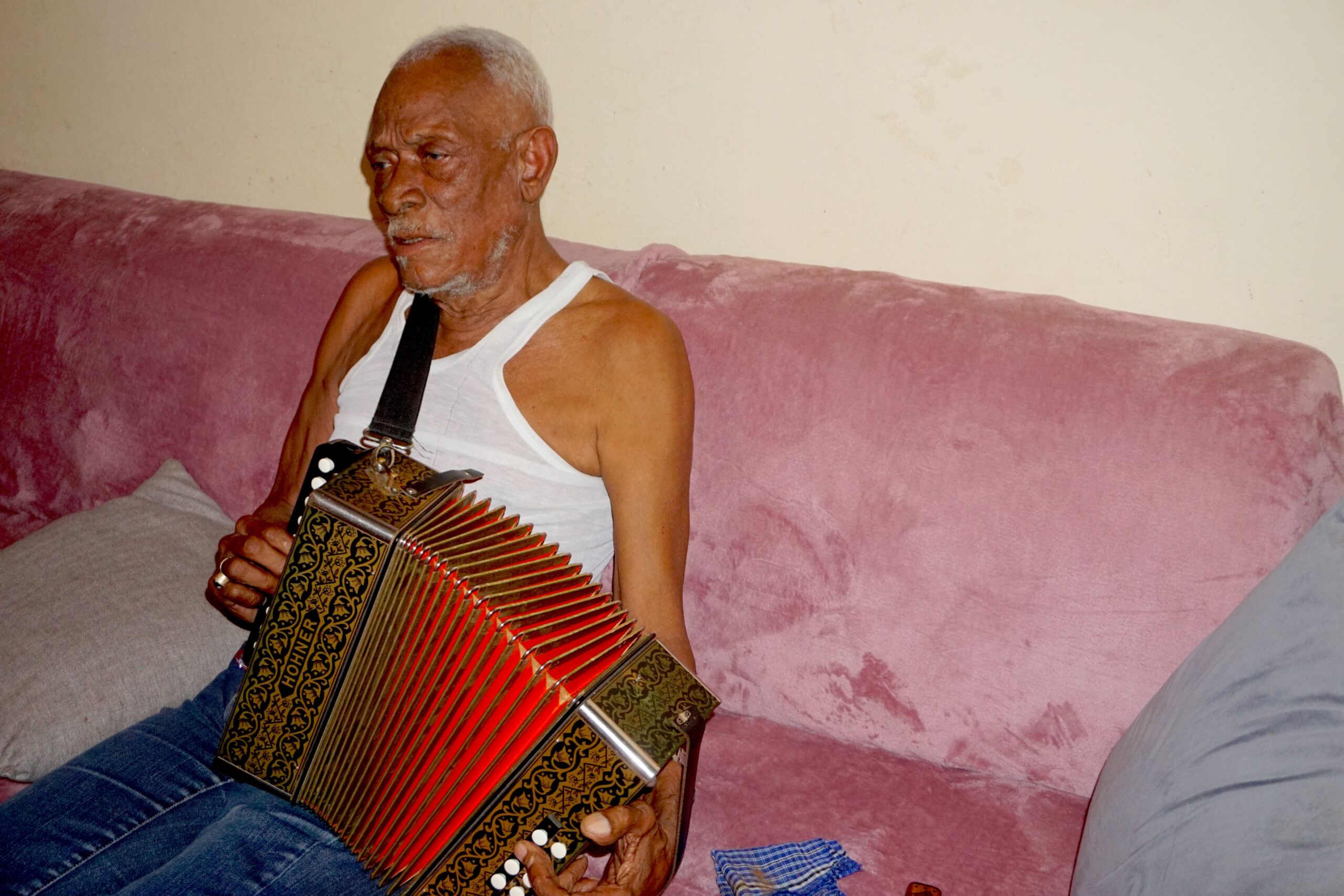
And when one must entrust their prized instrument to the tinkering of a luthier, there’s only one name on everyone’s lips: Belo Freire. Belo is one of those artisans without whom the sound of modern funaná would not exist. An outstanding luthier, he is also a successful accordionist, singer, and composer, at the heart of a musical family: his wife, Maria Augusta, played the ferrinho, and all their children play the accordion. Nila, Nildo, Nito, Nelito, Gilito, Lito, Titiu, and Belito play funaná, as does Edna, the youngest. The patriarch’s fame is such that the prime minister himself would pay him a home visit—complete with an impromptu jam session—whenever he traveled to the region on business. It must be said that, in addition to building and modifying accordions, Belo Freire contributed to the revival of funaná. With his band in the early 21st century, he paved the way for its illustrious offshoot, the cotxi-pó—a “2.0” version of funaná, powered by a drum machine running at a minimum of 160 bpm and featuring soukous bass lines, which added speed and energy to the genre.
Belo Freire, widely regarded as the inventor of cotxi-pó, lives in the interior of this region, more than an hour’s drive from the capital, in the lush valley overlooked by the Picos Mountains. In these areas, isolated from major urban centers, postal addresses are merely an administrative formality, and it is often with the help of friends, relatives, and neighbors that one finally knocks on the right door. The Freire family lives on a large property on the side of the valley, along a long, winding road. The first building is the family home, one floor of which is occupied by Belo’s studio. The backyard is the realm of the chickens and the vegetable garden, with a view of the children’s annex below, where the siblings sleep, study, and play music. The accordion is everywhere—in the children’s bedrooms, in the framed photos in the living room, and in the air. There’s no set time for playing it, for studying its subtleties, or for getting to know this heavy cube, which you literally hold against your chest, as if it were a newborn baby.
“When the accordion arrives from Germany or Italy, it’s not yet ready for funaná. Everything has to be modified,” explains the inventor of the cotxi-pó, as he takes an accordion apart right before our eyes. He removes the wooden block into which the reeds are inserted—those metal, leather, or plastic strips that vibrate when the bellows open and close. By scraping these reeds he can alter their length—and thus the pitch of the notes—and then fine-tune the sound’s intensity using strips of plastic film. This is how Belo achieves the vibrato and tone that best complement the singer’s “head voice.”
It’s a common technique for this instrument, in Cape Verde as elsewhere in the world, but one that requires precision, a good ear, and patience. This is not the Belo Freire of the eponymous group’s 2000s music videos – frantic and wild. Funaná, once again, is all about contrasts and paradoxes, just like the isolated African land where it originated.
The paradox that defines the genre is also rooted in the class-based racism to which it has fallen victim: until the late 1970s, funaná was confined to the rural regions of the island of Santiago and had no place in the capital, Praia. Even after the country gained political independence, the genre remained stigmatized as rustic and failed to capture the interest of the national cultural elites. In Cape Verde, rural and urban music are closely tied to the islands’ geography. It wasn’t until the sounds of Bulimundo emerged that funaná broke down this social divide.
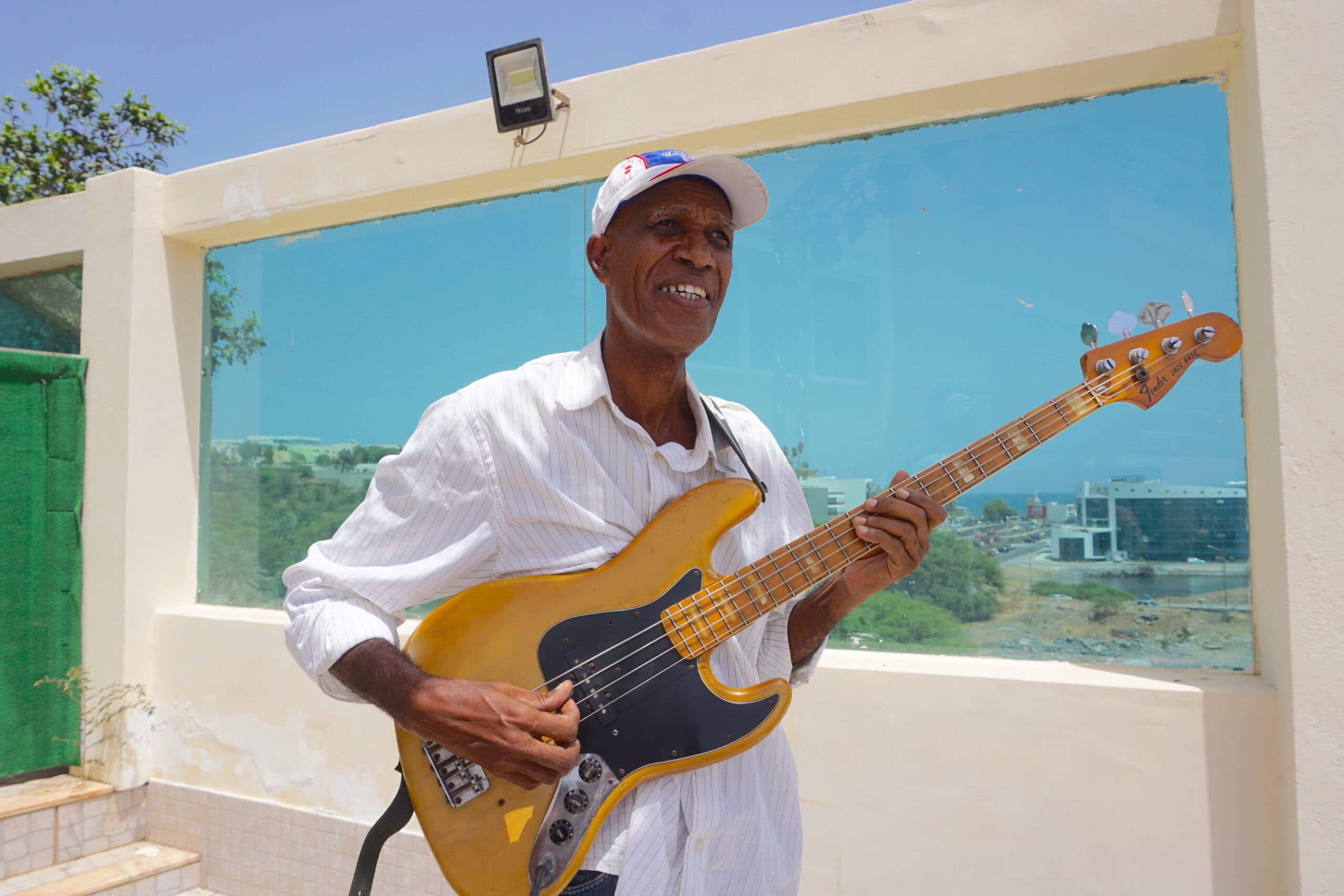
An iconic band on the Cape Verdean music scene, founded by Katchas and the brothers Zezé and Zeca di Nha Reinalda, Bulimundo revitalized the genre by adapting traditional instrumentation to a modern, almost rock-style band format. Thus, the ferrinho is replaced by the hi-hat on the drum set, which adds a powerful kick. The left-hand part of the gaita is now played on the neck of an electric bass, while the right-hand part is handled by the synthesizer and electric guitar. As for the head voice—here, that of Zeca di Nha Reinalda, the undisputed king of emotion—it is amplified through a microphone. This amplified funaná electrified audiences in the capital and eventually found its way to other major cities across the diaspora.
In the wake of Bulimundo, numerous other groups emerged—sometimes sharing musicians—during the golden age of orchestral funaná. These included Tubarões, Finaçon, Tulipa Negra, Norberto Tavares, and João Cirilo—all Cape Verdeans, though often residing between the archipelago, Lisbon, and Rotterdam. The international funaná scene took shape and continued to grow, always with and for its own diaspora, even serving at times as a local political token when the post-independence, Marxist-leaning one-party regime (PAICG/PAICV) gave way to a pluralistic democracy beginning in 1990. But here, there was no lasting political co-optation of a cultural practice that has always avoided becoming watered down, whitewashed, or institutionalized.
For one question underlies every local conversation, every outside observation, every political agenda: What is the African heritage of funaná? And by extension, what is Cape Verde’s African identity? Does its population identify as African or Afro-European? Is funaná’s African heritage too pronounced? These are all questions that continue to engage researchers, institutions, and musicologists. The subject highlights the thorny issue of Creole identity, which underlies virtually all of the archipelago’s relationships with the rest of the world, as well as those between the islands themselves. This is the observation made by anthropologist Rui Cidra in one of the few serious studies on funaná. In Funaná, Race, and Masculinity: A Postcolonial Trajectory, the researcher explains:
“The aesthetics built around funaná reveal the tension between two currents of Cape Verdean creolity: on the one hand, the hegemonic vision of a literate creolity—championed by the middle classes and the cultural and political elites—which is based on narratives of cultural exchange [...] with the Portuguese, Europeans, and Brazilians [...], without offering any critical reflection on the asymmetry of power relations. On the other hand, the construction of a Creole identity and a narrative [...] in which funaná is embedded, grounded in the violence of enslavement during the Atlantic slave trade, the practices of self-empowerment and resistance by slaves who fled to the interior of the island of Santiago, and their employment as peasants in semi-forced contract labor in São Tomé and Príncipe.”
To this analysis, we can also add that, according to Portugal’s colonialist propaganda, mixed-race Cape Verdeans were considered closer to Europeans than were the colonized populations on the African continent, who were deemed too black. As a result, many mid-level positions in the Portuguese colonial administration in Africa were reserved for the Cape Verdean intellectual elite. When independence was celebrated in 1975, a period of pan-African pride began. Then, in 1991, there was a shift in tone with the end of the one-party system and the adoption of a new national flag—the three African colors were replaced by an Atlanticist blue. From then on, successive governments—the PAICV and the MpD—would relentlessly celebrate cultural mixing as the defining characteristic of the population, which they described as “neither African nor Portuguese”. This has resulted in policies of economic and cultural rapprochement and collaboration with Europe and the United States, in an attempt to gain a measure of credibility on the Western stage. These strategies have left deep-seated tensions and a certain sense of identity confusion in contemporary society.
It is only very recently, and mainly on the island of Santiago, that identity issues seem to be gradually resolving themselves through a renewed appreciation of the connection to the African continent. While in 2019 UNESCO added morna—the music of the islands of Boavista and Brava, popularized around the world by Cesária Évora—to the Intangible Cultural Heritage of Humanity, funaná must for now be content with inclusion on the national heritage list, a recent and symbolic decision adopted by the Ministry of Culture in April 2024.
More generally, while the African roots of the language, songs, rhythms, culinary heritage, and way of life are now better highlighted and shared, neighboring Africa still sometimes remains a mirage in the midst of Cape Verde’s identity. Like two poles between which one navigates by sight. Both a glittering Holy Grail and a taboo foil, like that bouncy bassline that cotxi-pó borrowed from the soukouss of the Congo. “The average Cape Verdean could never play like that. Unless he embraces his African identity,” jokes Princezito, a nationally recognized musician and enthusiastic analyst of Cape Verdean music.